December 19, 2011

Munich and Bavaria

After leaving Switzerland we took a train out of Lucern to Munich, visiting a city that is renowned for all the typical stereotypes of Germany; liederhosen, steins of beer and huge beerhalls.... essentially the characteristics of the region known as Bavaria (Bayern). We stayed at a hostel right outside the central Hauptbanhof and had three days to explore the city and the region. Switzerland had left us exhausted and craving the comforts of Germany that we had grown to love, and Munich did not disappoint. We took a day trip to visit some world-famous, beer-brewing Monks at the Andechs Monastery, and took another day to venture to Munich's outskirts to visit Dachau, the first Nazi concentration camp. In between we sampled many varieties of Bavarian eateries, which we grew quite fond of. We were particularly obsessed with the traditional Munich breakfast of "weisswurst" (Bavarian veal sausage, packed with savory meat and subtle herbs) and pretzels served with sweet mustard. And of course, served with a beer. We (Dave) challenged ourselves one morning to be the earliest beer-drinkers at the restaurant, and it was not even close. We entered a wursthaus at 9:30 am and nearly everyone was drinking a beer already. Christina's order of a coffee seemed to truly throw the waitress through a loop and indeed we imagined that the coffee machine hadn't even been turned on yet. 

In any case we'll keep this entry brief and let the pictures do the talking. The scene at the infamous Hofbrauhaus was so wonderfully wacky that we actually took a video of the thing to try and capture what it was like. 


Oh, the tender caress of a German liter upon one's cheek. Switzerland had been hard on us, and Munich welcomed us with open arms and piping schnitzel.

The entrance to Dachau, where prisoners passed through the gate promising that "Work will set you free."
"The Bunker" at Dachau, where Nazi officers were based and special prisoners and interrogations were held. The doors shown here were to the holding cells, cramped spaces that felt rank with history. Some had plaques commemorating notable prisoners but most were vacant and spare.
A view of the prisoners' holding barracks, one of which has been reconstructed. Only the foundations have been maintained for the rest. At the far end is the crematorium. A terrible, grim place, but one we're glad to have seen.
The walkway leading up to the Andechs Monastery and Brewery. A glorious place.

Seeking the Monks who brew.

As is custom in Bavaria, restaurants are self-seating and contain only long tables where you find yourself sitting next to all manner of strangers. At Andechs we met this wonderful German couple, Greta and Willy. They introduced us to their beer preferences and a delicious cheese, paprika and beer spread that was great on pretzels, and then invited us to their home for a coffee before driving us to the S-Bahn station so as to save us from the taxi ride out of the mountains. Wonderful people.

Greta informed us of this Bavarian custom that we later saw at many other beerhalls, the "Stein Locker." Apparently these mug-shaped compartments are passed on from generation to generation, treasured and rarely made available to others, and then only by rigorous written application. Some of the locks looked like they were part of the passing-down, ancient and clunky things. Willy was giving an insider tip on how to procure a locker; call the Monastery every single day until they relented.
At the Hofbrauhaus, one of Munich's most famous beerhalls. Bavarian flavored chicken and a crispy pork steak, served with different varieties of potato. Uh-mazing.


Inside the Deutches Museum, a staggering six floors of technological and scientific history and exhibits.

December 14, 2011

Switzerland

After leaving the Lufts' farm, we knew any future work stay would have big shoes to fill. It was tough to say goodbye to the place we had come to know as home for over month.  We departed the Lufts on a Thursday morning bound for a train to Hamburg and then the overnight City Line train to Zurich, Switzerland. We were new to overnight train travel, but the City Night Line did not disappoint. Although we had not reserved a spot in the snazzy overnight births of the train, we did have very comfortable, reclining seats at the rear of the train and were not too far from the dining car - a dimly lit car serving up a few German specialities and of course, plenty of beer and wine. We ordered up some drinks and read our books before retiring to our reclining chairs for the evening.

David, Marcel Luft, Ute Luft and Christina outside the Lufts' home. You can follow the Lufts' life of self sustainability at Luft.de...the site is in German and any webpage auto-translations will be sloppy, but a hope of ours is to be a part of the translation/transfer of this information and knowledge into English. Stay tuned.
We arrived in Switzerland on Friday a little tired and in need of a good shower, but eager to explore a new country and meet our new host family.  Immediately, our experience in the Zurich hauptbonhof paled in comparison to any German train station we had spent considerable time in.   While we heard Switzerland was expensive, we were not prepared for just how outrageously expensive.  As far as the exchange rate from Dollars to Swiss Francs is concerned, the Swiss Franc was definitely better than the Euro, however, this exchange rate did us little favors given the high cost of goods in Switzerland.  The lockers at the train station cost us twice as much as our storage lockers in Hamburg, and a small wheat roll at the bakery was half the size and twice the cost as any we encountered in Germany. Although we asked others why Switzerland was so expensive, few could provide a clear explanation. After some preliminary online research we discovered the Switzerland contains one of the world's most stable economies. The Swiss have one of the lowest unemployment rates and the highest per capita incomes in the world. It is not a case of creative license when the Swiss banks are mentioned in movies as a place to white wash otherwise unclean money. Switzerland is in fact a safe haven for foreign investors. Today, it's largest industries include banking, chemical manufacturing, and precision and musical instruments.  Quite a few multinational corporations are Swiss, including Nestle, Hoffman-La Roche, Credit Suisse and the Swatch Group.

Our host family in Switzerland lived just outside of Lucern in the small village of Menzberg. From Zurich we took an hour long train ride and then a bus through steep Swiss hills.   Our family had not planned to pick us up from the train station, so armed with some rather unorthodox directions, we made our way to their farm house.  As we walked our way through town the views of the hills and the Alps were breathtaking. Although we took many photos, our one shot camera struggled to capture the picturesque landscape.  

A view of Menzberg from one of its many surrounding hills. 
The Bussman's, our host family, are dairy farmers, and together five adult children (ages 18-28), the grandparents and mom and dad live in a very large Swiss farm house. Immediately upon our arrival the mother exclaimed "Aye, aye, aye."  Although we had arrived earlier than she expected, we were not prepared for this less than enthusiastic greeting. Still, we did our best to quietly settle into our room and acquaint ourselves with the neighborhood. Eventually, Mrs. Bussman (Therese), came by our room to check in.  She immediately informed us she was not prepared to have us stay on the farm for the length of time we had previously discussed. We were certainly disappointed and caught off guard, as we had pre-arranged these dates months earlier. Although this conversation did little to help us feel welcomed, we accepted her limits and began making plans for an earlier departure. After a long few days of travel and a rather unwelcoming arrival, we felt rather weary and homesick.  Convinced that perhaps we had just started off on the wrong foot, we donned our two pairs of long johns and joined the family for dinner and a special outdoor Advent celebration, complete with St. Nicholas, live sheep and local children dressed up as the three Magi. The celebration was organized by the Catholic church in town, which many locals attend regularly.

Our first dinner at the Bussman's proved to be a jarring experience. Therese had prepared two Swiss pastries, one containing apples and cheese and the other a mixture of cheeses. While the pastries were tasty, we immediately noticed the family did not use plates or napkins. Each child cut pieces of the pastry with their bare hands and ate directly off the wooden kitchen table. Our pastries were consumed with piping hot milk - a regular drink at meals. 

Part of the wonder of traveling is the exploration of the way other people live, and thus an understanding of how they approach the problems of the world. We are open and eager to experience and interact with the world through the lens of our host families, and are not afraid to live their lives. That being said, as teachers, thinkers and readers we also know it is important to question the habits and beliefs of others. Questioning is the beginning of critical thinking. So, when Therese asked us not to wash her dishes with soap we politely questioned this practice, only to learn she did not believe in the existence of bacteria. During subsequent meals we watched this family with dirt caked hands, touch food meant for the entire table, lick their personal utensils and then place them in communal serving bowls to grab seconds and ultimately not wash their dishes. Meanwhile each member of the family seemed to be battling a cold. With each meal we became increasingly worried about the habits of the Bussmans, if for nothing else out of fear for our own health as travelers.  Finally, in an effort to keep ourselves healthy, and after being asked to only dry and put away dishes, we decided to discretely and as respectfully as possible, wash our dishes, with soap, before each meal. This was, apparently the last straw for Therese.  She confronted us about our discreet dish washing and insisted that if we wanted to wash our dishes, we had to leave her home. Perhaps if the Bussmans had been kinder people we could have been able to overlook the lack of table manners and the disbelief in bacteria. However, the Bussman's were not kind to us as travelers. When they did speak to us or ask us questions, they made many rude and snide remarks. In addition, despite the entire family's ability to speak English, they never spoke to us during meals, and instead, they spoke to each other in rapid Swiss German, never including us. This was certainly a shift from the inclusive and welcoming home of the Lufts.  Our Swiss experience taught us that each party approaching the workaway experience brings different hopes and dreams to the table. Some people, like the Lufts, hope to share their vision and practices. Others like the Bussman's seem to be looking for laborers and are not as interested in sharing their way of life.

Despite the disappointing and often times disturbing experiences in Switzerland, all was not lost and we will have some fond memories of our time in Switzerland. After being asked to leave the Bussman's we met up with the Hellmessen's (Anita and Ronnie), a young couple who lived just outside of Switzerland. We were so grateful for Anita's welcoming nature and hospitality we called her our angel. Anita and Ronnie live outside of Lucern in an area known locally as Little Yugo.  The area is mainly populated by immigrants to Switzerland. Anita and Ronnie have two beautiful, and incredibly intelligent children, Jason (age 5) and Justin (age 2).  Anita lived in the apartment above her sister, Sina, who had an adorable litte boy named David (age 1.5). We spent our last few days in Switzerland, helping this family through the daily chores of life and learning more about a very different side of the country. Sadly, what Anita and Sina had to share did not improve our view of Switzerland. Although Anita and Sina had lived in Switzerland since they were toddlers, and although they spoke flawless German Swiss, the Swiss themselves did not accept these Albanians (who emigrated from Kosovo) as true Swiss.  In fact, Sina, who married a Nigerian man, was afraid to take her young, mixed son, David out in public for fear of the racist comments and actions of ignorant Swiss citizens. According to this family hate crimes were not rare in Switzerland and Sina had more often than not been a victim of such hateful speech and actions. Despite their busy and sometimes difficult lives, Anita and Sina took us in as family members. They were incredibly generous people and were eager to share their lives with us. Together we cooked delicious meals,  played with the children and enjoyed the beautiful view of the Alps from her balcony.

Although both the Bussman's and the Hellmessen's had not traveled far from their homes their approach to others was drastically different. The Bussman's put on airs of superiority and often treated us as ignorant city dwellers. The Hellmessen's were curious about the world, and hopeful that one day they too could travel outside of Switzerland. In some ways we can be grateful to both families as they showed us sides of Switzerland we would never have encountered as mere tourists.


David, Anita and Christina at Cafe Sperber. This cafe became our refuge in Menzberg and a welcome spot for a drink, weiss (white) wine for Christina and an Eichhof (Switzerland's mainstay beer) for Dave. The chef and owner served us delicious local cuisine, including a schnitzel to die for and some wonderful venison stew served over spetzle noodles. 

It has been an unusually warm winter in Europe this far. This was the first snowfall in the Alps. 
A view of the snow covered hills of Switzerland and a true rarity in these parts, an enthusiastic woman of color.

Unlike the Lufts' the Bussman's were running a small scale factory farm. In winter the cows are kept tethered in the stables. The cows were enormous.

A view of Lucern from the main bridge. Though a beautiful city that was tucked right beneath the alps, it was hard not to lament our rapidly emptying pockets.

December 5, 2011

The Final Week in Weitsche

We returned from our trip to Amsterdam on Thanksgiving Thursday. The American take on Halloween and Christmas looks somewhat similar in Germany, which makes sense given that these are holidays that involve massive consumer-friendly traditions that both marketing forces and eager kids are happy to see exported all over the world (i.e gifts and candy). Thanksgiving, on the other hand, means little to other countries (for obvious reasons) nor does it provide many chances to sell things, so the holiday threatened to pass us by without anyone around us giving the slightest notice. This was compounded by us spending the day taking the train out of the Netherlands. All was not lost for us though. When we arrived at the train station to be picked up by Ute and the Luft's youngest son Ben, they proposed that we go to dinner together at a local Italian restaurant where Marcel would join us for an outing. We were thrilled to have some type of fancy meal to honor the occasion, and we were thrilled to be able to share it with the newest and closest family we had, the Lufts. And that's how we found ourselves at an Italian restaurant in rural Germany toasting to an American holiday. We couldn't have asked for anything better, given the circumstances, and we felt such love for the Lufts by then that we could avoid feeling the lack of our families back home. We were then lucky to be able to chat over Skype with the various gatherings of our family groups (Christina's in Jersey, my brother's in Oakland, and my parent's in South Acworth). 

On Friday things truly began to gear up for the weekend's protest. The basic idea behind this demonstration, which we've referenced several times now, is that a yearly transport of nuclear waste from a plant in France is delivered to a rural town in Lower Saxony that is very close to the Luft's home in Weitsche. Aside from the dangers revealed by nuclear power plant accidents, exposed in the still-emerging details of the Fukishima power plant disaster in Japan, storage of nuclear waste remains one of the long-term problems with nuclear power. Germany, for all its brilliance in engineering, is no better at dealing with this than anyone else, and year after year this transport comes from France and is delivered to a storage facility that is still deemed only temporary until a new, more permanent solution is built. As it is now though, massive stocks of waste are accruing at this rural site and appropriately infuriating many of the local (and even non-local) Germans into action. 

Therefore every year for several years now the 'Stop Castor' movement revs up in the form of a massive demonstration and protest that is both meant to bring awareness to this issue and, more tangibly, to block the railway so that the transport itself is stopped and indefinitely delayed in a form of non-violent protest. Every year the protest grows and every year the locals speak with pride about how many days the transport is upheld; this year set the record at six (five days delayed in Germany, and even one day delayed in France). 

Many things are striking about this, but two stood out in particular. First, people rallied with a feistiness that we've come to appreciate as one of the most endearing German traits. The count put the total number of protesters at about 20,000 or so, and they streamed in from the surrounding countryside for days leading up to the event, filling up random fields with tents and the ubiquitous yellow X's that symbolize the movement. Farmers in particular turned out en masse, and many others practiced glorious forms of protest on the actual rail tracks in attempts to stop the passing train. Every year it is something different. In a previous year Greenpeace brought in a huge cargo vehicle that was labeled as a beer truck and which "stalled" right on top of one of the rail crossings, the hapless driver unable to restart his engine in the face of angry polizei. After a time (according to legend), the sides of the truck rolled up to reveal a Greenpeace banner and people poured out of the truck from a cage tucked behind a false back of stacked beer bottles. This year a small group of farmers chained themselves together in a human pyramid over one section of track, their thick chains specially engineered to thwart polizei and any attempts at unlocking or severing. The police could do nothing, and eventually the farmers unlocked themselves after 15 hours (!) when they could no longer avoid eating and going to the bathroom. Great stuff.

The second standout was the ridiculous police presence. The police also poured in from the surrounding environs, reportedly numbering 19,000 by the height of the protest, nearly a one-to-one ratio if we can trust everyones' estimates. For the few days leading up to the weekend the blue and white Polizei vans were EVERYWHERE on these winding country roads, throwing up random roadblocks and strutting around in full riot gear, ready for something serious to break out. To Christina and I, their presence was unnerving and it shocked us how the Germans tolerated their constant hassling with little ire. The cops seemed more likely to create an incident than to diffuse one in our mind, and we felt sure that it was the kind of situation that would very quickly escalate in America for nothing more than their overwhelming, in-your-face visibility. 

In any case, we attended the march that led us to the major rally and demonstration, where MC's stoked the crowd and speakers boomed on about the importance of the movement. We were somewhat separated from the tracks themselves, but the atmosphere was charged and thrilling. Granted we understood nothing that was said, as we were immediately separated from our host Lufts by the throngs of people, but that further attests to how powerful a scene it was. 

In the end, to our knowledge, there were no major incidents. The transport, as it always does, eventually arrived, the bastard powers-that-be just waiting until everyone got the civil disobedience out of their system before quietly delivering the rotten goods in the dark of night after the protests wound down and everyone inevitably had to return to their weekday work and lives. And the massive pile of nuclear waste only grows bigger in its entirely inadequate storage facilities. This was equally as troubling as the demonstration had been exciting, but as Marcel told us, this is how the game works. The people hope to draw bigger and bigger notice to the event every year until eventually something gives way and the government responds. It pains us to think, but perhaps that will only be when there is incident, when an escalation occurs between cops and protesters that shocks the political system in a way that is typical only to tragedy or violence. We shall see.

Aside from the protest, we did our best to soak up the last days of Weitsche, this little German town that has come to be very dear to us. We spent time with many of the gracious and welcoming neighbors that we had come to know over the previous four weeks, often times sharing stories and drinks late into the evenings right up until our departure. Christiana and Horst, who avid-readers will recall cooked a hell of a pumpkin stew, took us on a great driving trip/pub-crawl and had us to dinner again. We grew to love them as dear friends. Likewise Voelke, a neighboring farmer, took us in on the evening of the town Christmas tree lighting, and before we could say no the schnappes and wine and Jaegermeister were flowing like...well, like wine, schappes and Jagermeister flow in Germany (we can't say water, because no one ever drinks water here, it's true). Christina may or may not have nursed Dave over a hangover after that one, though the record is a bit fuzzy. Voelke's proudly showcased American classic rock collection is perhaps to blame, who knows.

We took a few last bike rides, soaked up a few last bits of knowledge from Ute and Marcel (bread-baking and brewing in particular), and enjoyed one last rural German staple by attending the local Christmas Markt. We loved our time in Weitsche and we loved the Lufts. They are warm and thoughtful and what they are doing there in Weistche is truly a local act informed by global realities. We are determined to maintain our relationship with them and after many talks into the night we know now how much our visions align in terms of what we want our lives to look like and how to spread the message about living with meaning in a world of dwindling ecological health. Marcel and Ute, we'll miss you but we'll sure as hell be seeing you again.


Before baking bread, Ute grinds unprocessed wheat to create flour.  Ute searched far and wide for this mill, which has a strong motor and contains a drawer for collecting the flour. The mill is from a local German company which has been making such mills for over three generations. 

After mixing the flour with water until the correct consistency is achieved, the flour is kneaded and placed into baking tins. I am told, the older the tins, the better the bread. 


Throughout Weitsche and the surrounding villages, families showed their support for the demonstration with signs, yellow X's and the occasional warmly dressed scarecrow.  

We watched from the side of the road as farmers in over 200 tractors processed to the protest site. 

Concerned citizens lined the streets in support of farmers and bikers. 

The beats from Greenpeace drummers helped ignite calls of STOP CASTOR. 


Protestors met at two major meeting points and then processed to the cornfield for speeches and rally cries.  This is the front line of one such procession. 

The majority of protestors gathered on a large field near the tracks for speeches and musical entertainment. 

David's ongoing photo series : The Polizei Presence. 

The Polizei Presence: Note the helicopter above the protestors. 

After a night of Jagermeister, the Weihnacht Markt's array of hearty soups and sausages was a godsend, and worth the long bike ride. 

David nearly shouted for joy when we emerged from the woods  to find the Weihnact Markt and it's array of hangover cures.

During our last bike ride we were finally able to capture a photo of the windmills lining the countryside.  

Part of the ongoing series: Bikes in the Countryside

The covered heap on the right is a store of giant sugar beets.  This is a unique storage method used by several farmers in the area. 


It would be impossible to address our final week in Weitsche without speaking of the terrible accident that took place on the Sunday of the protest weekend. Both of the Lufts' college-age sons, Jan (20) and Jonas (18) returned enthusiastically for the protest and we were thrilled to meet them. Jonas himself was actually the one who drove us to the Castor demonstration and walked us into the mass of people on that preceding Saturday. He had returned from school with a close friend of his and was reuniting with other friends of his from back home. On Sunday night he was driving with two such companions when a gust of wind nudged his vehicle into the gravel at the road's edge and the car struck a tree and rolled several times into an adjacent field. Jonas emerged physically unscathed but his two friends were killed instantly. It was utterly tragic, mind-numbingly so. The boys were merely 18 and 21 years old.

Utes' parents and countless neighbors from the village arrived quickly to provide support, and Christina and I did our best to be of help. We felt grateful that we at least knew the farm well enough to take all related tasks off the Luft's plate for the few remaining days we were in Weitsche, while they focused on supporting Jonas and each other. Details came in throughout Sunday night, and we learned the worst when Marcel returned from the hospital, leaving Ute to stay with their son. We sat with Marcel then, and when he asked to share a beer we drank with him and hugged him tight until he retired for the first of many sleepless nights. We said little because there was little to say.

Our hearts go out the families of the boys and to Jonas and the Lufts as they do their best to process events that defy any attempts to do so. There was no excessive speed nor any substances involved, which makes it all the harder to deal with and wrap up in a box and say "here is what we learned from all this." It was a blessing that of all the possible and understandable responses, the families of the boys were not interested in blame and only wanted to join Jonas in navigating their grief. If anything, as Marcel said, it is a harsh reminder that life is not a game and needs to be lived full in whatever fleeting time we've got.

Until the next.


November 29, 2011

Amsterdam


With the blessing of our wonderful host Lufts, we decided to leave our temporary home here in Weitsche a bit later than anticipated. We asked Marcel and Ute if we could leave our room unoccupied for the week and afford ourselves the ability to pack light for a brief exploration of a city that has long intrigued the both of us, Amsterdam. We would then return to Weitsche the following weekend in order to attend the upcoming demonstration against the nuclear waste transport coming in from France. A later entry will cover the 'Stop Castor' event, but Amsterdam came first.

The ever-efficient German trains carried us through northwestern Germany and into the darkening fog of the Netherlands. After a few transfers, we emerged out of Amsterdam Centraal station and looked for the public transport that would bring us to our hotel. We decided to avoid the hostel experience for fear of the mental state/capacity of any potential roommates in a city like Amsterdam. Instead we cashed in some credit card points and opted for the Westcord Art Hotel, an excellent and relatively cheap hotel that was well away from the central strip(s). We would recommend this place to anyone looking for such digs in Amsterdam.

We promptly found out that Sunday night was in the middle of the annual public transport workers strike and we'd have no choice but to take a cab to the outskirts, essentially ending our evening. We weren't ready for that yet, so we took to the streets immediately outside the central station and were swallowed by the massive throngs of people and the eerie fog. We ate at an overpriced Chinese restaurant, stumbled  awkward and overly-self conscious into our first coffeshop, and eventually escaped the neon chaos back to our hotel. Dave again tipped a European cab driver way too damn much.

Over the next three days we explored this insane place. We are fully aware that we saw very little of what the Netherlands are like as a whole because Amsterdam itself is filled with tourists and non-Dutch. Still though, it was a provocative and fast-paced city. There are thousands of bikes, tens of thousands surely... bikes everywhere. And everyone is riding them in and out of car and foot traffic on these bike paths, ringing their little bells if an American is walking outside the specifically-defined pedestrian lanes in their way. And no one wears helmets, it's amazing. We actually conducted an informal experiment to count bike helmets and for the following 2 days of our stay we saw, to our increasing surprise, exactly zero helmets on bicyclists, and only 4 helmets in total if we included motorized bikes (mopeds, vespas). Also, few had a multi-gear bike. They were all these old clunkers that had one gear, many of them modified to hold up to 3 children. A fascinating thing to see, and very different.

We saw several great museums. We both stared in awe at Rembrandts' and Monets' masterpieces in the Rijksmuseum and saw the classic self-portraits at the Van Gogh Museum. We were somewhat disappointed with the Dutch Resistance Museum. It had plenty of buttons that did nothing when pushed, weird, dated exhibits that seemed to be made in the 1980's, and much of the verbage about Dutch resistance did not translate very well. On the other end of the spectrum we saw the infamous Red Light district, which was exactly what it had been made out to be and ultimately seemed somewhat bored with itself. One underwear clad woman was eating a box of chinese food in her window, looking unimpressed. Granted, we were there at about 3pm but definitely not something we've often seen. 

There were plenty of fascinating bars and restaurants and coffeeshops with true character, and we left the city feeling satisfied and ready to be gone. Amsterdam was a great place to visit. That dark and foggy night when we first wandered out of Centraal station, right into the thick of it and in the midst of a transit strike, will surely be a lasting memory from this trip.


You'll see a lot of this in Amsterdam... tourists with maps, identifying landmarks.
Christina in front of the Rijksmuseum, housing the Dutch masters.
Amsterdam Centraal Station. Note the bikes.

The main street leading out from Amsterdam Centraal Station.
Amsterdam's architecture was impressive. A large number of canals form concentric rings around the city.

You are rarely more than a shady side-street away from a coffeeshop. They only serve juice and coffee in these shops, never alcohol, which is probably a good idea.
 
A common bike modification that we saw. Groceries, kids... anything could go in that front cabin, though obviously if it was kids there were no helmets. 

A cool vegetable market that lined a canal, leading to another famous street market at Albert Cuypstraat.
We tried to capture a shot with all the madness of Amsterdam's roads in one frame. Cars, trams, motorized bikes, regular bikes, and cowering pedestrains... and a couple dashes of white paint. 
This was nighttime and poor lighting, but this was Amsterdam's Occupy Protest. 

November 23, 2011

Week 3: Change, Renewal and a trip to Berlin

I: Week 3 In Weitsche

In week three we saw life and death on the farm, the process of renewal and change. Two pigs, Pinkie and Blackie (a different Blackie from Blackie the rabbit) were relieved of duty, while two goats showed up, as did a few baby chickens that were born in a tucked away corner of the barn.  Ben, the Lufts' youngest son, found them nestled in the hay.  Our Australian friends Sean and Larissa also left us; they've moved on to Majorca for another workaway stay and then on to the rest of the world.   We furthered our appreciation of the Lufts home brew by witnessing the early stages of its production in the Witch's Kitchen (Ute's laboratory anex. It is here that soap making, wool preparation and beer brewing all happen).  Although it has grown colder, there is still much to prepare on the farm. This week we also planted trees, prepared a barn room for new construction and took part in a good ole fashion community rake fest. Life in Weitsche is never dull.


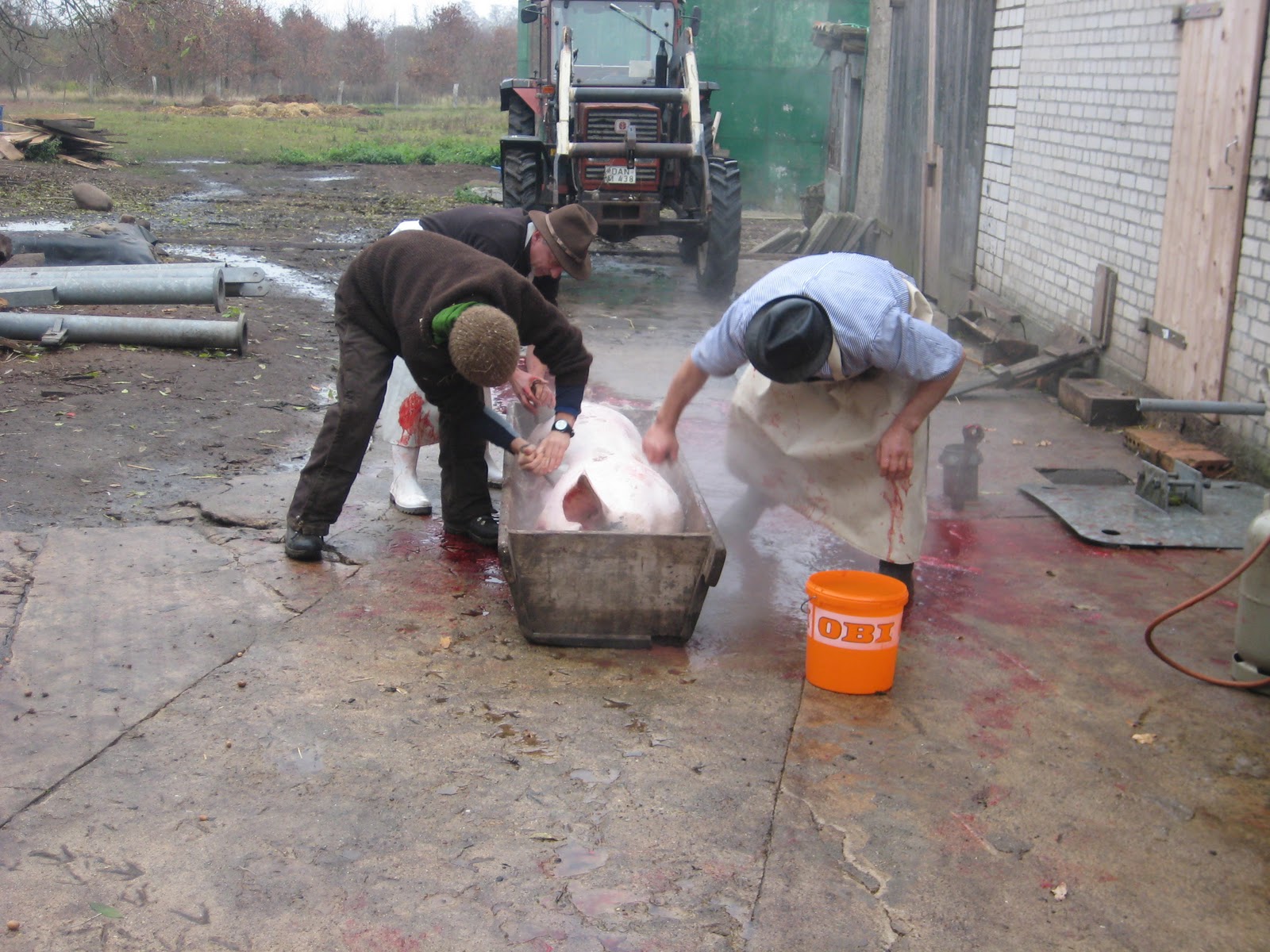
After a bolt to the head stunned the pig, our new butcher friend delivered a single knife incision to the heart and it was over in 20 seconds. Cleaning and scraping ensued. 


Having removed the insides our friend delicately splits the pig in two halves. We are two shots of schnappes in at this point.
Christina raking madly at the town raking party. Note the banner in the background. It speaks of the nuclear waste storage issue at hand in the upcoming protest. A story about last year's protest.
The tractor stops and the rakes go up for a coffee break (with maybe a little bit of rum and beer).

Some of the new additions to the farm; Bill, Barry, Bart, Bonnie and Bertha, clockwise from left.

Ute's beer workshop. Here she is putting water through the boiled barley to remove all the starch, which will ultimately be converted to sugar and then eaten by the yeast (we think).

The payoff. Beers and books by a bonfire. Thursday happy hour in Weitsche.

II: A Weekend in Berlin

Shortly after the pig slaughter, we showered and headed off to Berlin for the weekend.  Carrying our guide book, a small backpack and our respective reading material, we arrived in Berlin eager to explore the city.  Our experience in Berlin was exciting, thought provoking and at times intense.  

We stayed at the Pangea People Hostel just a few blocks from Alexanderplatz.  Our hostel was in many ways everything we'd hoped for and everything we expected. The rooms and bathrooms were wonderfully clean and the staff friendly and helpful. We did end up in a room with eight early-twenty something's and were privileged to their post discotech drunken singing at 5:45am, but it was a hostel after all.  The location of Pangea People turned out to be ideal as we were within a short walk of an internet cafe, several restaurants, and most importantly a public transportation hub. Berlin is a city composed of several neighborhoods. There is no official city center, and we did our best to explore as much of the city as possible.  Berlin is rich with history. We walked aside the Berlin wall, visited the museum of the famous artist - Kathe Kallowitz, walked through the Brandenburg gate, fell silent over a powerful exhibit on the site of the former Secret State Police headquarters, and blushed at exotic art from across the world. We were not at a loss for ways to engage with the city.  And in many ways the city left an indelible mark on us. After our trip to Berlin, and specifically The Topography of Terror museum, we are eager to engage in the necessary battles.

We couldn't quite figure out what was wrong with this picture, but it's two small things really....the younger German drinking age and no open container laws. Cheers boys.

Christina, always ready to cross divides. Here at the Berlin wall memorial.
The memorial had one of the longer preserved sections of the original wall. Though we made light of the situation at this moment, such activity would have gotten Dave shot in the 1960's.
Part of the preserved wall, including a watch tower and the demilitarized lane down the middle of the barrier.


One of the more moving pictures from the Topography of Terror  museum exhibit about the Nazi regime. Ask us about our book.

The Erotik Museum, the largest in the world. Also a shrine to Beate Uhse, the world's first (female) adult entertainment mogul. It all started as a way to inform 1940's women in rural Germany about contraception. 
One of the Erotik Museum's more tame exhibits, a legit, preserved tiger's penis. 

Over a memorial at the Babelplatz in Berlin, the location of the infamous Nazi book burning. The room below is filled with walls of empty bookshelves. 
The plaque at the Babelplatz book burning memorial with a quote by Heinrich Heine; "wherever they burn books they will also, in the end, burn human beings."

So many great spots in Berlin to have a Pils and a sausage.

An interesting difference between East and West Berlin is the walk signals... we believe the rigid, blocky guy is for what was formerly East Berlin...

... and the more accurately proportioned guy is from West Berlin. At the old Berlin Wall memorial this actually changes on a specific street corner. 
The Brandenburger Tor ("Gate"). This is a storied structure that serves as an entrance to the city of Berlin, and which every armed force (domestic or foreign) has accordingly marched right through anytime the city has been sieged or taken over throughout German history. Here, Dave storms through and makes his claim.

The Bundesteige, Germany's government building. Oddly, the hardest tourist attraction to access in all of Berlin.

The Hotel Adlon, opposite the Brandanburg Gate and otherwise not worth noting except to point out that it was the site of Michael Jackson's baby-dangling incident. R.I.P. Michael.