November 23, 2011

Week 3: Change, Renewal and a trip to Berlin

I: Week 3 In Weitsche

In week three we saw life and death on the farm, the process of renewal and change. Two pigs, Pinkie and Blackie (a different Blackie from Blackie the rabbit) were relieved of duty, while two goats showed up, as did a few baby chickens that were born in a tucked away corner of the barn.  Ben, the Lufts' youngest son, found them nestled in the hay.  Our Australian friends Sean and Larissa also left us; they've moved on to Majorca for another workaway stay and then on to the rest of the world.   We furthered our appreciation of the Lufts home brew by witnessing the early stages of its production in the Witch's Kitchen (Ute's laboratory anex. It is here that soap making, wool preparation and beer brewing all happen).  Although it has grown colder, there is still much to prepare on the farm. This week we also planted trees, prepared a barn room for new construction and took part in a good ole fashion community rake fest. Life in Weitsche is never dull.


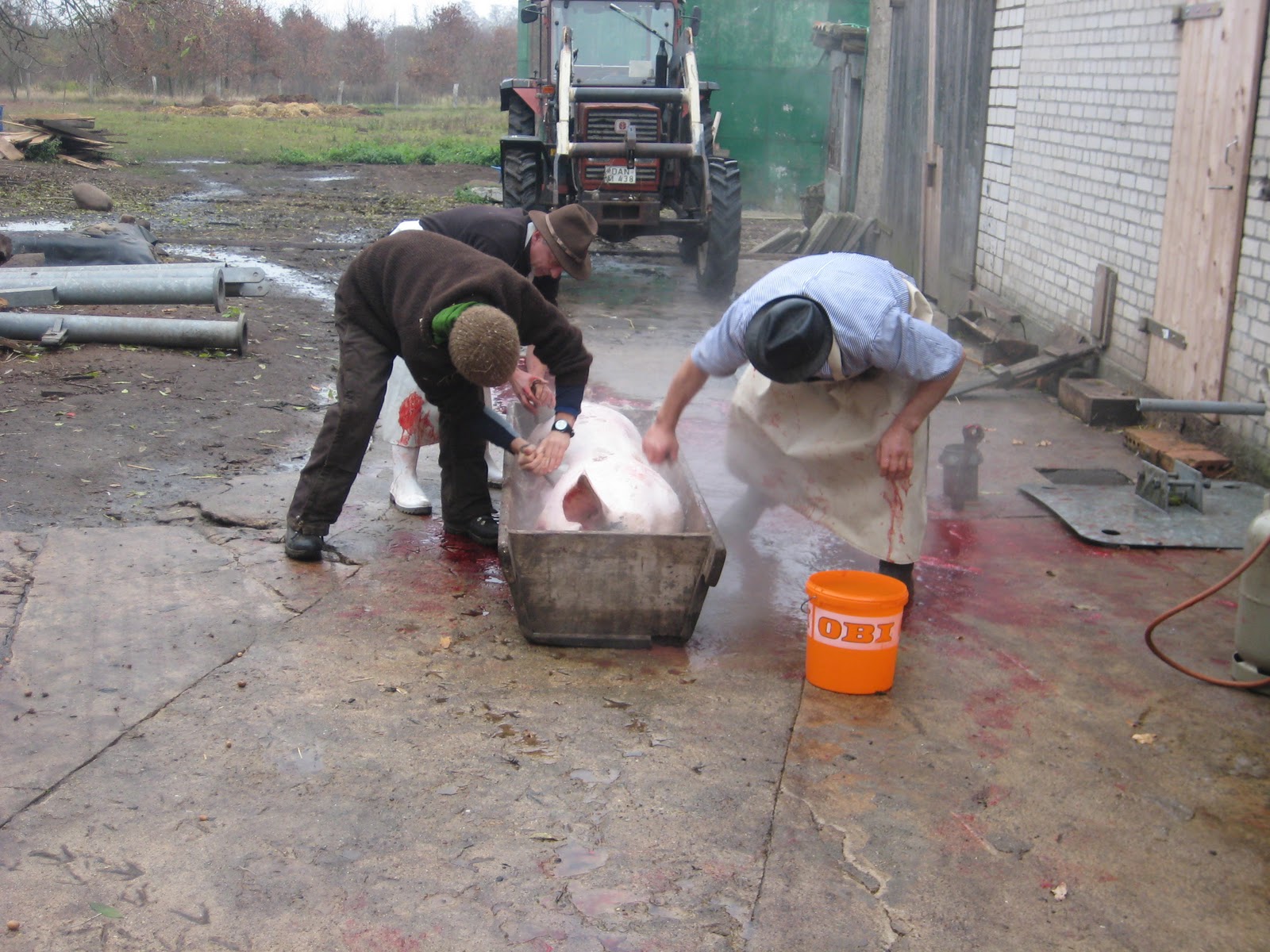
After a bolt to the head stunned the pig, our new butcher friend delivered a single knife incision to the heart and it was over in 20 seconds. Cleaning and scraping ensued. 


Having removed the insides our friend delicately splits the pig in two halves. We are two shots of schnappes in at this point.
Christina raking madly at the town raking party. Note the banner in the background. It speaks of the nuclear waste storage issue at hand in the upcoming protest. A story about last year's protest.
The tractor stops and the rakes go up for a coffee break (with maybe a little bit of rum and beer).

Some of the new additions to the farm; Bill, Barry, Bart, Bonnie and Bertha, clockwise from left.

Ute's beer workshop. Here she is putting water through the boiled barley to remove all the starch, which will ultimately be converted to sugar and then eaten by the yeast (we think).

The payoff. Beers and books by a bonfire. Thursday happy hour in Weitsche.

II: A Weekend in Berlin

Shortly after the pig slaughter, we showered and headed off to Berlin for the weekend.  Carrying our guide book, a small backpack and our respective reading material, we arrived in Berlin eager to explore the city.  Our experience in Berlin was exciting, thought provoking and at times intense.  

We stayed at the Pangea People Hostel just a few blocks from Alexanderplatz.  Our hostel was in many ways everything we'd hoped for and everything we expected. The rooms and bathrooms were wonderfully clean and the staff friendly and helpful. We did end up in a room with eight early-twenty something's and were privileged to their post discotech drunken singing at 5:45am, but it was a hostel after all.  The location of Pangea People turned out to be ideal as we were within a short walk of an internet cafe, several restaurants, and most importantly a public transportation hub. Berlin is a city composed of several neighborhoods. There is no official city center, and we did our best to explore as much of the city as possible.  Berlin is rich with history. We walked aside the Berlin wall, visited the museum of the famous artist - Kathe Kallowitz, walked through the Brandenburg gate, fell silent over a powerful exhibit on the site of the former Secret State Police headquarters, and blushed at exotic art from across the world. We were not at a loss for ways to engage with the city.  And in many ways the city left an indelible mark on us. After our trip to Berlin, and specifically The Topography of Terror museum, we are eager to engage in the necessary battles.

We couldn't quite figure out what was wrong with this picture, but it's two small things really....the younger German drinking age and no open container laws. Cheers boys.

Christina, always ready to cross divides. Here at the Berlin wall memorial.
The memorial had one of the longer preserved sections of the original wall. Though we made light of the situation at this moment, such activity would have gotten Dave shot in the 1960's.
Part of the preserved wall, including a watch tower and the demilitarized lane down the middle of the barrier.


One of the more moving pictures from the Topography of Terror  museum exhibit about the Nazi regime. Ask us about our book.

The Erotik Museum, the largest in the world. Also a shrine to Beate Uhse, the world's first (female) adult entertainment mogul. It all started as a way to inform 1940's women in rural Germany about contraception. 
One of the Erotik Museum's more tame exhibits, a legit, preserved tiger's penis. 

Over a memorial at the Babelplatz in Berlin, the location of the infamous Nazi book burning. The room below is filled with walls of empty bookshelves. 
The plaque at the Babelplatz book burning memorial with a quote by Heinrich Heine; "wherever they burn books they will also, in the end, burn human beings."

So many great spots in Berlin to have a Pils and a sausage.

An interesting difference between East and West Berlin is the walk signals... we believe the rigid, blocky guy is for what was formerly East Berlin...

... and the more accurately proportioned guy is from West Berlin. At the old Berlin Wall memorial this actually changes on a specific street corner. 
The Brandenburger Tor ("Gate"). This is a storied structure that serves as an entrance to the city of Berlin, and which every armed force (domestic or foreign) has accordingly marched right through anytime the city has been sieged or taken over throughout German history. Here, Dave storms through and makes his claim.

The Bundesteige, Germany's government building. Oddly, the hardest tourist attraction to access in all of Berlin.

The Hotel Adlon, opposite the Brandanburg Gate and otherwise not worth noting except to point out that it was the site of Michael Jackson's baby-dangling incident. R.I.P. Michael.


November 10, 2011

Blackie The Rabbit

This is primarily for Charles Bradt, though anyone who is interested in slaughtering game, raising rabbits, or our trip should check this out. It's not pretty though, and it speaks to one of the key challenges of doing these things on your own farm. You raise the animal and care for it, and then you kill the animal and eat it. Cringing at this has seemed dishonest to us given that we both eat meat, and we've tried to jump right in to these kinds of experiences for that specific reason. Seeing this process in full rounds out the picture. We literally were feeding this rabbit five minutes prior to the first picture. Blackie, we called him. He was big and friendly as rabbits go and he had a beautiful black coat, hence the name. On this fateful Friday morning we were feeding him as we'd grown accustomed to, patting him lovingly all the while, when Marcel abruptly stepped out of the barn telling us to stop, that we would be having roast rabbit on Sunday, that the rabbit should have an empty stomach when slaughtered, and that Blackie was the one. The pictures tell the rest. 

Blackie, this is for you. 


It begins. Blackie was a good rabbit, and a good earthling. His passing was valued greatly and happened about 2 minutes prior to this picture.

Note the early stages look similar to a poodle haircut. Cuts along the legs allow the fur to be peeled down the body of the rabbit.

The entire pelt rolls right off the torso... 

...and catches around the head. Tree-pruning loppers came into play here, thankfully undocumented.

An incision is made into the stomach of now hairless and headless Blackie. Note Christina yawning... two weeks on the farm has hardened her, apparently.

Two days later, ready to be prepped for stew.

First, the back legs are removed at the joint. 

The front legs follow. Interesting that only flaps of skin and tendon attach the front legs,  no major bone sockets.

The strips below the rib cage are removed next, to be diced later.

Marcel locates the lowest rib and cuts down to the backbone on both sides of the rabbit.
Having separated the rib cage by severing the spine, Marcel uses a paring knife to pull "filets" from the  outside of the ribcage. And yes, he's wearing chainmail, though sadly it stops at a glove. Half Michael, half medieval. Awesome.
Strips between the rib bones have been removed. Marcel is now dicing any large boneless sections in preparation for the stew. 
Spaetzle (the 'ae' is actually an umlaut ) being made, a traditional German pasta that served as the side for our Rabbit Feast. 

The Rabbit Feast. From left to right are Ute, Christina, Dave, Sean and Marcel. Didn't realize how much flannel was happening at the time, but whatever, Sean and I are farmers now and we can do that.

A plate at the Rabbit Feast. A leg, some sauteed sweet carrots, and some spaetzle with the delicious, thick gravy made from rabbit pan drippings.  Delicious. Memorable. A night-killer - nothing to do after eating but smile and go to bed.

November 8, 2011

Week 2: Things Get Serious

This week, we took life at the Lufts head on. There were many firsts to be had. 

Monday was Halloween - a day not celebrated in Germany. Although it is growing in popularity as candy companies advertise and package candy for the day, it is not a part of German tradition. Halloween went almost entirely unnoticed for us except for Ben, the Lufts' son, who arrived to dinner dressed, we think, as a ringwraith.


The week seemed to fly by and this was due in part to a dinner party we attended on Monday night. Marcel and Ute's gracious neighbors, Christiane and Horst, invited us over for English Night - Kurbiseintopf (Literally translated as Pumpkin One Pot) and English conversation.  The retired couple lives next door to the Lufts in a renovated farm house.  We were greeted at the door and invited into their dining room where an inviting fire and seasonally decorated table awaited us. Christiane and Horst further reinforced our notion of the Germans as a convivial bunch who can certainly handle their liquor. Christiane served a delicious pumpkin stew. The tureen seemed bottomless as we each helped ourselves to second and third servings of the warming and tasty meal. While Christiane replenished the crusty bread and stew, Horst continually refilled our beer and wine glasses.  It was a marvelous night of fascinating conversation and good company. Fairly early in the evening the conversation turned to politics, the state of the world and how to garner the interest and involvement of the youth. Big issues and serious topics for us here in Weitsche.  The people here and the Lufts' way of life provide hope in what sometimes seems like a bleak forecast for the future.

Despite our late night, Tuesday began bright and early at 7:30am with David's first chicken slaughtering. We'll let the pictures speak for themselves. Overall it was an intense and informative experience. Surely we won't be able to look at meat counters the same anymore. As Marcel always reminds us, it takes a bit of time to do this process well, especially if you expand the idea of "the process" to raising and providing for the chickens. Much has to be adjusted or abridged or entirely lost when the process achieves larger economies of scale.
David and the chicken prepare themselves for the inevitable. Does the hen know what's coming here, we wonder? 
First, the chicken is hit on the head with a small club. This step is mandatory in Germany. If we do this ever again, we're buying a chamber mechanism where gas knocks the bird out, not a club. This was the troubling part. 

With an axe, the chicken's head is chopped off.  Actually this was the troubling part.
The bird is then dipped in boiling water and plucked. 

David carrying away the plucked chickens.  He also participates in the gutting of the animals.

Marcel tells us that Germany tradition calls for the liver of the killed animal to be given to the hunter. Here is the chicken liver served with onions, salt and pepper....

...and here is the 'hunter,' loosely interpreted.

The huntress was not so impressed at first. 

The chicken slaughtering was not the only first of the week. This week, I (Christina) went on my first bike ride.  Thanks to my patient bike instructor, I finally moved beyond the rounds in the village circle.  We went on several long bike rides this week and I can confidently say I know how to ride a bike. 

After several days of increasing distance we finally rode to the town of Luchow, which is 8km away. Cars zoom by rather frequently on this road and they do not seem inclined to stop, so we ultimately opted for a series of small roads that run parallel to the canal.

Since learning of the canal path, our bike rides have been quite peaceful.  This Sunday it was rather foggy.  The mist created the illusion of riding under moon light.


There were also many firsts in the kitchen this week, including, American Burger Night (complete with homemade buns), traditional Bavarian Pretzel Sunday and a delicious rabbit roast. 


Homemade hamburger buns. With Ute's help, we were able to bake some pretty delicious and simple buns.

Hamburger Night would not be complete without the perfect fry. These were soaked in sugar water and fried twice. Needless to say they were a hit.


The pumpkin stew and hamburger roll recipes are posted on our recipe page. Guten apetit! 
We'll soon post a special entry devoted to Blackie the rabbit and his ultimate fate.


October 30, 2011

Week 1: Lufting it in Weitsche


After signing out of the Apartment Hotel, which was a great space that we'd recommend to anyone traveling through Hamburg, we hunkered down at the Hamburg Hauptbanhopf to wait for the train that would take us to our first work-stay of the trip. The train station was great for some good old people watching.  We were particularly amused by an older gentleman who seemed to spend his day collecting the half finished cigarettes of smokers. Kind of gross, but he certainly found plenty of butts. One thing that has jumped out at us is Germany has LOTS of smokers. Anyways, by mid-afternoon we had boarded the first train, which took us to Lunenberg, a town about 45 minutes west of Hamburg.

When traveling with all your belongings on your back in central Hamburg, it's important to maintain a sense of space. 
We switched trains at that point, hustled across the rail tracks to the secondary launch station and then boarded another train that took us another hour or so to Dannenberg. On the train ride we met up with Sean and Larissa, a young Australian couple that has been working and staying at the same work-stay in Germany. We got to meet each other on the train and have been working with them since. They're fun, exciting people who are having an adventure of their own, traveling the world for a good 18 months. We arrived together in Dannenberg and were soon picked up by Marcel Luft, one half of the husband/wife team that owns and operates the farm. Skinny, winding roads brought us past fields upon fields and we eventually entered a cluster of beautiful old farmhouses that were huddled together around an intersection of three major roads, home to about 50 people. We had arrived at Weitsche.

Whatever you do, don't pick up this guy.
La Casa de Luft. Solar panels make them electrically self-sufficient when averaged over the year.

If you see this sign, you're there. Butt-lost, but you're there.


Indicative of what most of the farmhouses look like in Weitsche...and actually showing what roughly half of the farmhouses look like in Weitsche.
The surrounding environs...and a beauty rarely seen in these parts. 

So we settled in on Sunday night, and Monday morning we got into it. The farm consists of a few adjoined buildings where the Luft family and their work-awayers live and eat and sleep. Spaced around the periphery of the central yard are two large farmhouse buildings, a large vegetable garden and a sprawling livestock area where chickens, geese and ducks spend their days yukking it up. Four pigs are divided into two pens, one for the two piglets and one for the two hulking males who are (or should be) counting down the days until the cruel irony of their heavy diet is revealed to them. 

In our first week we've already settled into the routine. We rise in the morning and gather for a light breakfast of toast and coffee, then are out working by 9am, taking on the tasks of the day. Each morning starts with the animals, making sure they are fed and happy. We then move on to the tasks of fall, which at this point have included harvesting and storing some late-season vegetables for the winter (potatoes, celery root, carrots, hulking beets), preparing the grounds for the winter season, and working on various foodstuffs and drinks that will provide sustenance for the winter months ahead. We break for the day at around 1pm, when some of the group begin cooking lunch, which is the big, hot meal of the day, and after lunch our time is our own. Everyone gathers for a light dinner later in the evening, usually bread, cheese, and various spreads (the liver pate is particularly good). After a bite and perhaps a taste of plum wine or Ute's home brew, everyone retires to do it again the next day. 

We work closely with both Marcel and his wife Ute, who have proved to be vast resources of knowledge. What they accomplish here is undeniably impressive. They expertly utilize the fruits of their farm and the diverse skills of their townfolk and neighbors to operate almost entirely at self-sufficiency. Nothing is wasted and much is crafted that would otherwise be bought, from sweaters made of wool that was spun in-house and sheared from sheep in the back field, to wines made from harvested plums and cherries. And most delightful of all are the humans in the equation, Marcel and Ute, who have opened up their home and their experience here to share with anyone that is willing to dive right in. Their work here is not vaguely informed or defined; they have a vision of what they are trying to do and it fits into a larger vision of the world that is honest and appropriately conscious of how destructive normal human society tends to be towards the natural world and the fabric of community and life. They don't show up through the lens of American stereotype. This is not some hippie commune with spacey notions of harmonious living, but people who are living out a commitment to principles that work, principles that need to work. Marcel is still actively working (albeit on a part-time, self-chosen basis) as a network administrator for many local towns (including Weitsche...the internet I'm now accessing is traveling through infrastructure that Marcel put up himself). Ute herself was (is) Germany's first female web programmer. That is to say that these are people who are plugged in to technology and use it to serve their work here. We know already that we'll miss them terribly when it comes time to board the next train.
This sight greets us every morning as the birds rush us for the daily offering of stale bread, graciously offered up by a local bakery every two weeks. The geese are maniacs.

Feeding the rabbits and trying not to get attached...these are food rabbits, not cuddly rabbits.

Christina, the piglet whisperer.

The beer is homemade, and really good. Ute is quite the brewmaster. The Christmas batch was just bottled...

Sean and Larissa, our new Australian friends, working on smashing down cabbage with layers of salt into a special-made sauerkraut pot. The outer rim fills with water, allowing a ceramic cap to sit there and provide a seal that only allows air to escape.
That is Christina and Marcel plucking a recently-killed chicken. The headless duck on the table was next.
Dave boiling some crab apples for what we'll call "apple wine." 
Dave and Marcel putting beets and carrots into winter storage...a barrier of straw bales protects layers of veggies and straw, which was then covered entirely with patches of sod. Interesting storage technique.